
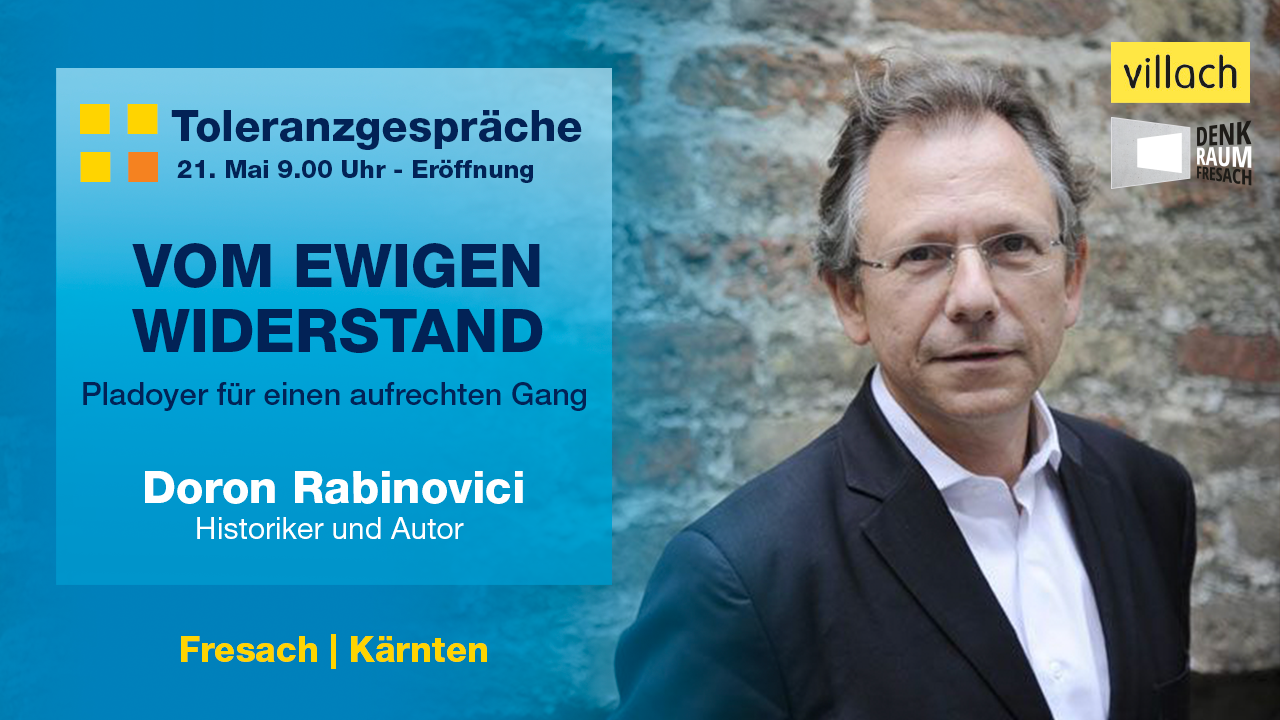
Resistance, rebellion, and revolutions against authority and totalitarian systems have accompanied human history from the very beginning. But what factors contribute to the success of such rebellion? The 12th European Tolerance Talks 2026 in the Carinthian mountain village of Fresach attempt to provide answers. The opening address on May 21 will be given by the Viennese historian and author Doron Rabinovici. Tickets and registration are available on the website: http://www.fresach.org/anmeldung
When the world descends into chaos or even becomes a prison with no exit, there are only two options: to sit idly by and watch, or to rebel. Humanity is adept at suffering, but also at resisting injustice and oppression, which often leads to outbreaks of violence and—as recently happened in Iran—only exacerbates the oppression. Concepts like “love” or “responsibility” are difficult to apply to political realities, especially in times when the enemy resorts to heavy weapons.
Doron Rabinovici is the guest of honor and keynote speaker for 2026. The multi-award-winning author is one of the country’s most prominent literary voices; his books address resentment and racism, antisemitism, and resistance. With the escalation of the Middle East conflict and Israel’s violent actions against its neighbors, he too is deeply affected, as his own family history is one of persecution and displacement. He advocates for “walking upright” and speaks in Fresach “On Eternal Resistance.”
Following the opening address, a political panel discussion will explore the question of how far resistance can go without causing greater harm, and where responsibility and consideration are preferable to pressure and violence. The recent example of Viktor Orbán’s removal from office in Budapest will be analyzed by Hungarian political scientist Melani Barlai, while ARD correspondent Susanne Glass and EU Ambassador Thomas Peyker will offer an external perspective through a European lens. Bestselling author Dimitré Dinev shares his very personal experiences of dealing with resistance.
In the afternoon, the focus shifts to nothing less than “revolution” and poetic “resistance against the prevailing conditions.” The 100th anniversary of Ingeborg Bachmann’s birth provides the occasion for a panel discussion featuring Bachmann experts Irene Fußl from Salzburg, Simone Schönett from Carinthia, Ines Charlotte Knoll from Vienna, and ORF filmmaker Barbara Frank, who discovered lost recordings while tracing the great poet’s life. The discussion will be moderated by Katharina Herzmansky, director of the Ingeborg Bachmann House in Klagenfurt.
The highlight of the afternoon is an ecumenical-theological panel discussion on the antagonism between “resistance and loving one’s enemy.” Loving one’s enemy means seeing them with different eyes, says Benedictine monk Anselm Grün. Hatred and revenge can only be overcome through nonviolence and a willingness to reconcile. Psychotherapist Arnold Mettnitzer, the president of Catholic Action, Ferdinand Kaineder, the Protestant superintendent Andrea Mattioli, and Islam critic Mina Ahadi will discuss this intriguing topic. More at pressetext