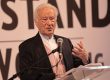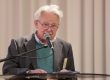

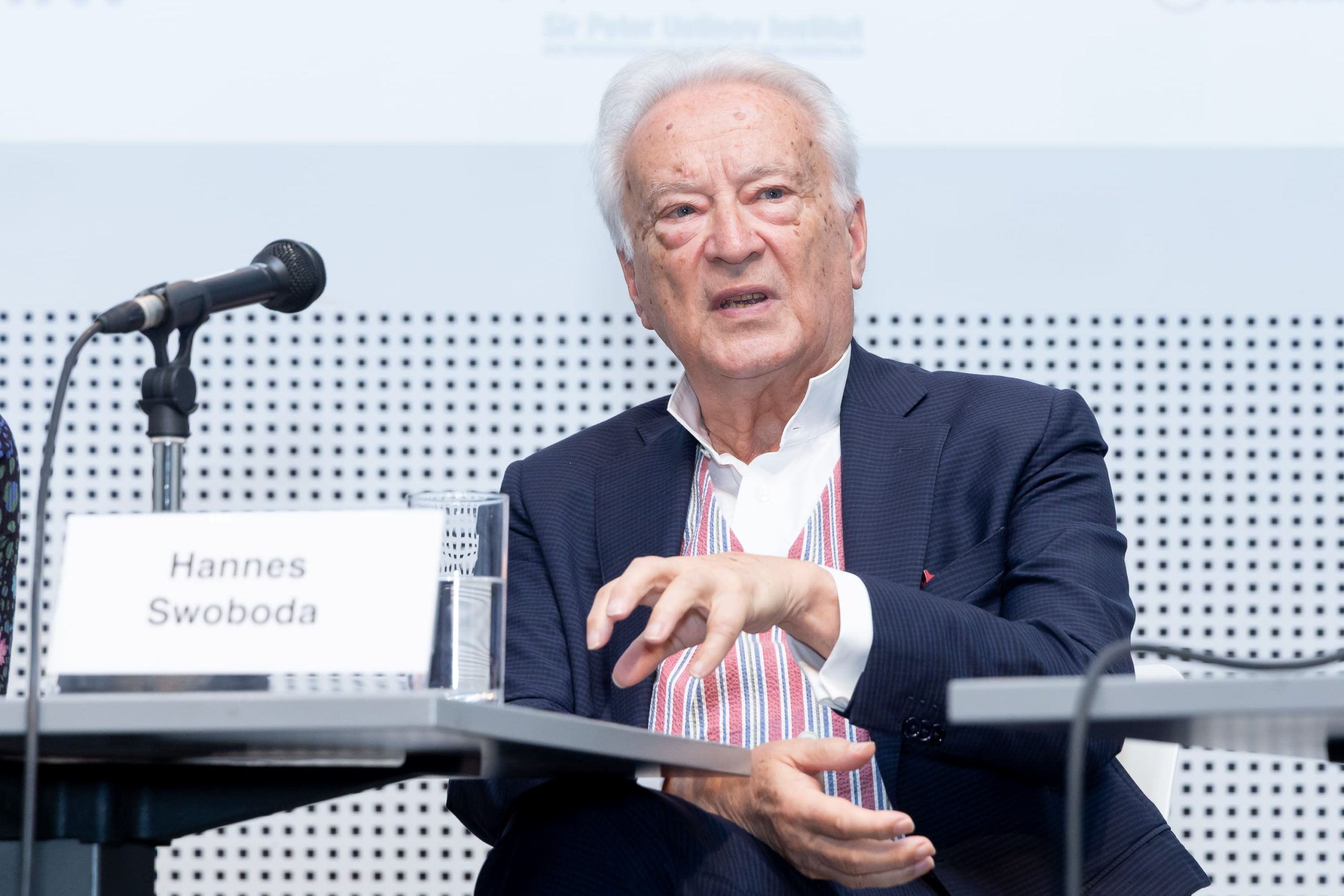
Last weekend, the Architekturzentrum Wien (Architecture Centre Vienna) was bathed in blue. Under the theme “Europe’s Acid Test,” numerous figures from politics, business, and civil society gathered to honor the socio-political commitment of Hannes Swoboda on the occasion of his 80th birthday. Mayor Michael Ludwig quoted the man of the hour, who once remarked: “There is too little Europe, and there is too little courage. We will only be able to hold our own in international competition by working together—not least to defend our model of democracy.”
Following his long tenure with the Chamber of Labour and the Vienna State Parliament, Swoboda served as Executive City Councillor for Urban Planning and Transport from 1988 to 1996. During this time, he transformed Vienna into a “laboratory for Europe,” revitalizing the city’s *Gürtel* (ring road) area with the help of EU funding and forging ties with Eastern Europe. After moving to the European Parliament, he led the SPÖ delegation, served as vice-president and parliamentary group manager, and—from 2012 to 2014—chaired the S&D Group. Throughout this period and beyond, he focused particularly on issues that “no one else wanted to touch for a long time.”
After retiring from active politics, Swoboda took on the presidency of the Architekturzentrum Wien, the European Tolerance Talks in Fresach, and the supervisory board of the University of Applied Sciences Campus Wien. He also assumed the presidency of the International Institute for Peace (IIP) and the Sir Peter Ustinov Institute. According to organizer Stephanie Fenkart of the IIP, the anniversary symposium was designed as a “mini-portrait” of Hannes Swoboda himself.
In the first panel, titled “Can Europe Engage in Global Politics?”, political scientist Astrid Séville from Leuphana University Lüneburg emphasized that relinquishing certain national sovereign rights actually represents a “gain in power” for Europe as a whole. In contrast, Austrian Armed Forces analyst Markus Reisner assessed the current situation by stating: “The Russians may stand before us in rags, but they wield a sharp sword; we, meanwhile, stand there in a fine suit—but armed only with a pocketknife. We have plenty of tools, but the blade itself is quite small.”
“What Holds Europe Together from Within” was the title of the second panel, which focused on the many instances in recent years where taboos have been broken—terms that are now increasingly finding their way into everyday language. Linguist Ruth Wodak cited examples such as “remigration” and “people’s chancellor” (*Volkskanzler*). Consequently, public spaces are vital for countering polarization—both online and offline. According to Angelika Fitz of the Architekturzentrum (Architecture Center), such spaces force individuals to encounter people outside of their own “filter bubbles.”
Colonel Markus Reisner warned of the consequences of hybrid warfare, noting that “1,000 trolls are worth more than 100,000 soldiers.” Sascha Obrecht of the Karl Renner Institute reminded the audience that democracy is the only form of government that must be relearned every single day—likening it, as the German sociologist Oskar Negt once did, to “a muscle that requires training.” Addressing the issue of refugee flows, Hannes Swoboda argued that integration is, in reality, a two-way process—necessary both for those arriving and for those already present—as both groups may struggle to feel “at home.” His concluding appeal: “We need the courage to engage in conflict—coupled with the willingness to resolve such conflicts peacefully.”
More images are available via the photo service: https://fotodienst.pressetext.com/album/3857
The video can be viewed at: https://youtu.be/hDjtF1YK4hc